About this service
Build scalable, maintainable software with our experienced engineering teams. We deliver high-quality code and best practices that help your product succeed.
Go to service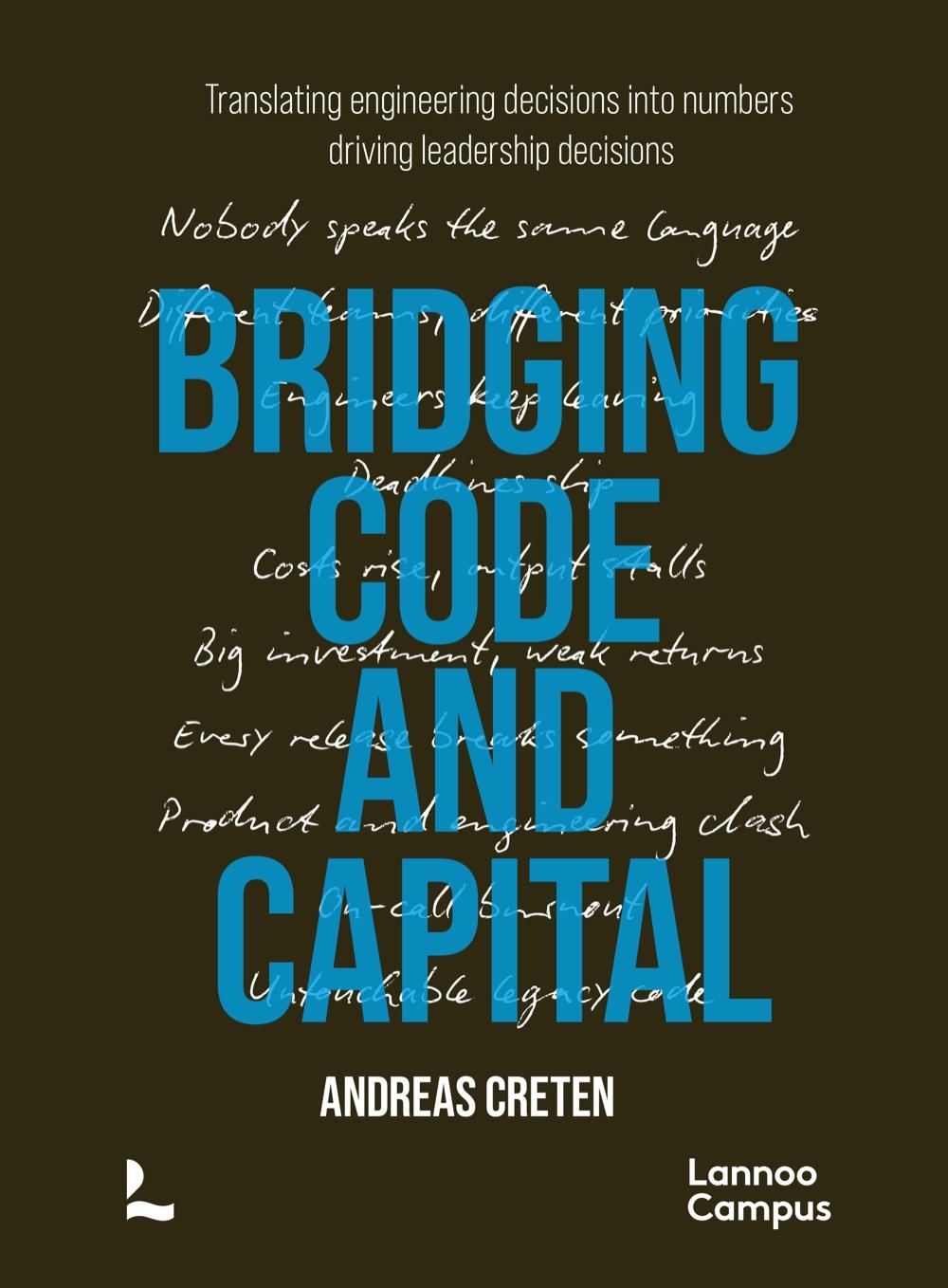
The Book
Out 13 October 2026Bridging Code and Capital
Translating engineering decisions into numbers driving leadership decisions
A book by Andreas Creten, published by Lannoo Campus
Engineers speak the language of velocity and technical debt. Executives speak burn rate and runway. Boards speak capital efficiency. Somewhere between them, the best decisions simply disappear. Bridging Code and Capital is the translator.
The problem
Three conversations. Zero translation.
Three languages. Three parallel universes that occasionally collide when something goes wrong. This book creates a shared language between them.
Engineers talk
- Velocity
- Code quality
- Technical debt
Executives talk
- Burn rate
- Runway
- Revenue growth
Boards talk
- Capital efficiency
- Unit economics
- Path to profitability
What you'll learn
Engineering through a business lens
It reveals what your organisation refuses to measure: the true economic impact of bugs, failed hires, technical debt and wrong bets. The point is the conversation where everyone understands what actually costs money, and why.
The cost of a bug
Every escaped bug has a financial signature. Learn to quantify the impact on churn, support costs, and revenue so you can make the case for quality investment.
The cost of technical debt
Technical debt is not just a developer problem. Understand how it slows velocity, increases CAC, and erodes margins, in numbers your board will understand.
The cost of building the wrong thing
The most expensive engineering decision is solving the wrong problem. A framework for understanding the full cost of misaligned product work before you commit.
The economics of build vs. buy
When does building in-house create competitive advantage, and when does it just create cost? A framework for making the decision with clear economic reasoning.
What's inside
Inside the book
Introduction
Translating Engineering Into Economics
Chapter 1
How Money Flows Through Engineering
Chapter 2
Measuring Throughput and Cost per Unit of Value
Chapter 3
The Cost of a Bug
Chapter 4
The Cost of a Bad Hire
Chapter 5
The Cost of Technical Debt
Chapter 6
The Cost of Changing the Roadmap
Chapter 7
The Cost of More Engineers
Chapter 8
The Cost of Manual Work
Chapter 9
The Economics of Build vs. Buy
Chapter 10
The Cost of a Rewrite
Chapter 11
The Cost of Building the Wrong Thing
Chapter 12
The Cost of Premature Optimisation
Chapter 13
The Cost of Cutting Corners
Chapter 14
The Cost of Externalising Development
Chapter 15
Putting It All Together
Chapter 16
Having the Conversation
Conclusion
What Changes
Who this is for
Written for both sides of the table
If you have ever watched a brilliant engineering decision get killed by a spreadsheet you don't understand, or watched leadership make a choice without grasping its technical implications, this book is written for you. Each chapter stands alone, so you can jump straight to the problem in front of you.
For executives and investors
Understand why your engineering team makes the decisions they do
Spot the difference between necessary technical investment and engineering gold-plating
Learn why hiring more engineers often makes things slower, not faster
Ask better questions in technical reviews and budget meetings
For engineering managers and technical leaders
Translate your instincts into arguments that resonate with CFOs and boards
Quantify code quality, hiring practices, and technical debt in terms non-technical stakeholders understand
Build a business case for technical investment that survives a budget review
Walk into roadmap discussions able to articulate the opportunity cost of every decision
From The SaaS Show
Hear Andreas talk about the book
Why twenty years of engineering decisions became economic formulas, and why those formulas survive the AI era.
Software engineering is not a cost centre.
It is a strategic investment that compounds over time.
Companies that understand this build better products, retain better people, and create more value with less capital. The ones that do not burn through cash, churn through people, and wonder why their competitors are moving faster despite spending less.
Stay updated
Get notified when the book is available
The book is out on 13 October 2026. Enter your details and we'll let you know the day it ships, or reserve a copy at Lannoo now.
Why bugs in production cost 100x more than bugs caught in development
Why bad hires destroy the value of your best people, not just their own salary
Why hiring more engineers often makes delivery slower, not faster
How to make the case for technical investment in terms CFOs and boards understand

About the author
Andreas Creten
CEO and co-founder, madewithlove
Andreas is CEO and co-founder of madewithlove, a company that supports product organisations with technical leadership. He has nearly two decades of experience as a fractional CTO, advisor and mentor, with a focus on technical due diligence for investors and interim leadership at scale-ups. He is also a frequently invited speaker at international conferences.
His mission is to bridge the gap between software engineers and their non-technical stakeholders. The technical leaders who excelled were not necessarily the best programmers. They were the ones who understood the economic impact of their decisions and could translate technical challenges into business realities for their stakeholders.
Lannoo Campus · Business, Leadership · ISBN 9789079967407
Newsletter
Andreas writes to investors once a month
Investor Insights takes the book's question, what engineering decisions mean for the business, into the companies we audit: three findings, three questions for your next board meeting, and a word from Andreas. Free, and short enough to read between two meetings.