



We all learned about general-purpose agents with OpenClaw. The idea was immediately compelling: one agent that could sit across tools, answer questions, take action, and gradually learn how we work. A system like that becomes powerful by getting access to more context, more tools, and more company and personal information. If the boundaries are unclear, that power quickly turns into discomfort. You start wondering whether you should really give it access to anything important.
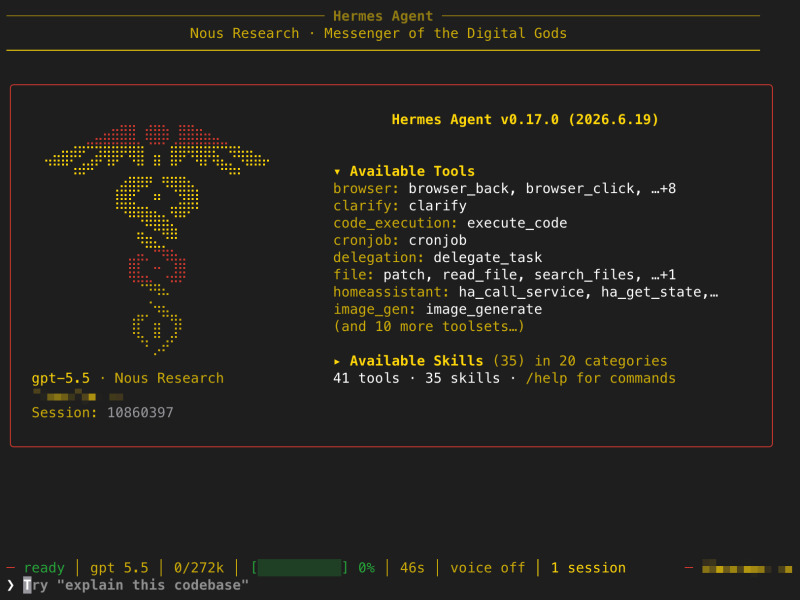
Hermes made the idea feel practical again. It is still a general-purpose agent, but the way it handles access and secrets changes the experience.
While OpenClaw gave me the feeling that I should be careful with every bit of access, Hermes is more explicit about the risks. If I give it too much access, it flags that. If I paste an API key into the conversation, it warns me that the key should be rotated because it is no longer safe. They make the system feel less like a clever demo and more like infrastructure you could experiment with responsibly.
More than an LLM subscription
Most of these systems are currently focused on personal use. You configure your own agent, connect your own tools, and slowly shape it around the way you work. There is a bigger opportunity on the company level.
What makes these systems interesting is not only that they can answer questions. They can gradually build up context from how people use them. The agent learns how your company works, what tools matter, where information lives, and what kind of help people actually need.
That is very different from giving everyone an LLM subscription. A subscription gives people access to a model. A general-purpose agent gives people access to a configured working environment. It can have the right tools connected, the right instructions loaded, the right memory layer attached, and the right boundaries in place.
That distinction matters most for people whose job is not to configure AI tooling. Engineers may be comfortable wiring together MCPs, skills, specialised agents, local files, and model settings. Most people should not have to be. If a company wants AI to become useful beyond the engineering team, it needs to provide something that works out of the box.
An agent where work already happens
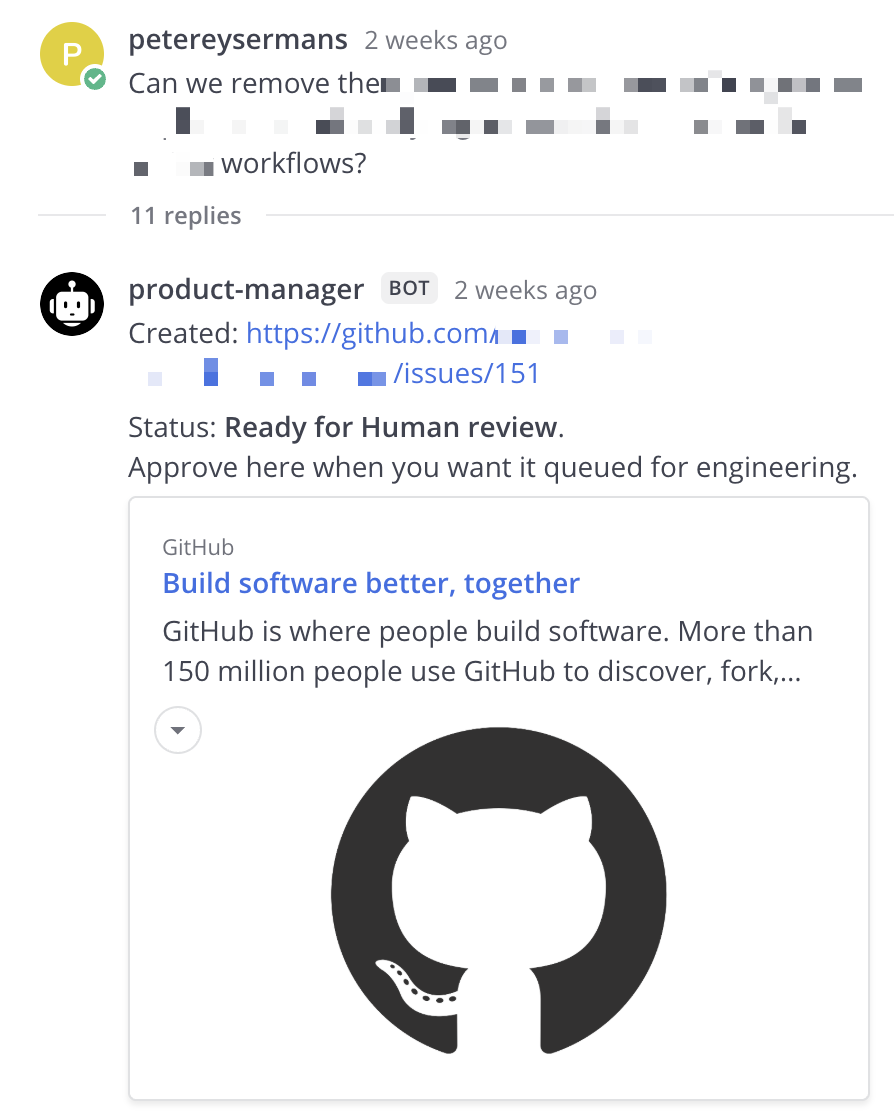
The value becomes clearer when the agent shows up where people already work. I have a software engineer agent and a product manager agent joining a project Slack channel to contribute as part of the team. The product manager picks up ideas and shapes them into a GitHub issue, passing it on to the software engineer agent. They move the project forward without asking people to leave the tools they already use.
That same pattern can apply elsewhere. A Microsoft Teams channel for late-night support could include an agent whose job is not to replace the human on call, but to provide context, suggest next steps, and reduce the amount of searching required under pressure. A sales agent connected to the CRM could help prepare account context before a call. A support agent connected to the HubSpot knowledge base could help people answer customer questions without manually searching through documentation.
This is infrastructure
There is a caveat. A self-hosted general-purpose agent is infrastructure. It needs maintenance and governance: rolling out updates and deciding which tools to connect and which data to expose. Hermes is moving quickly, so you cannot treat it as a polished SaaS product someone else will quietly maintain for you.
This is where self-hosting matters. If this kind of agent becomes a meaningful interface into how your company works, I would be uncomfortable handing all of that context to a commercial provider by default. The conversations, the connected tools, the memory layer, the files it writes, and the decisions it helps shape are not just chat history. They become operational knowledge.
We learned this with Fable, when access to a system people had started to rely on disappeared from one day to the next. Access and ownership matter. With something like Hermes, you control more of the important parts. You decide where the data is stored, which models to use and which files the agent can read and write. You are maintaining something you own.
Start experimenting
I do not think every company needs to roll this out to everyone tomorrow. These systems are still early, and Hermes is very much a moving target. But companies that aim to become AI-native should start experimenting with this.
The first version does not need to be grand. Give the agent a brief company overview, the team’s current goals, relevant product and process documentation, and a few carefully chosen tools. Let it support one team, one workflow, or one internal channel. Learn where it helps, where it fails, what access it needs, and what boundaries make people comfortable using it.
You can query documentation in Notion with Notion AI. A technical person can connect Jira to Claude with MCPs and build their own workflow. But that is not the same as giving the whole company a shared agentic layer: a configured environment with company context, connected tools, memory, and clear boundaries that works where people already work. If this proves useful only to people who know how to configure it, the company has not really adopted AI. A few power users have.


