



We did it.
After decades of science fiction, billions in research, obscene amounts of compute, and enough electricity to make a sustainability officer quietly close their laptop to compensate, artificial intelligence has finally reached the masses.
And we use it to rewrite emails.
Okay, that is slightly unfair.
We also use it to summarise documents we didn't want to read, make meeting agendas nobody wanted to write, ask questions we were too lazy to Google, and turn three bullet points into a LinkedIn post about authentic leadership.
AI adoption is booming.
Or, more accurately, AI chat adoption is booming.
For most people, those two things have become the same thing. AI is ChatGPT. Or Claude. Or Copilot. You open a little box, type something, and a remarkably intelligent machine types something back.
And granted, that little box is incredible.
You can give it a contract and ask what matters. You can drop in a spreadsheet and ask what looks weird. You can brainstorm a strategy, rewrite an angry email before HR gets involved, or ask it to explain your child's maths homework while carefully pretending you still remember how fractions work.
But there is something slightly absurd about all of this.
We built machines capable of reasoning across enormous amounts of information, gave them access to some of humanity's accumulated knowledge, and then put them behind a text box where they patiently wait for us to copy and paste things into them.
AI chat is a brain in a jar.
A very capable brain, admittedly. So naturally, we started drilling holes in the jar.
We gave AI connections to our tools. MCPs, connectors, integrations. Suddenly ChatGPT, Claude or Copilot could theoretically look inside SharePoint, read your documents, search your emails, query your CRM and rummage through all the other digital goodies we've piled up over the years like a corporate junkyard nobody quite remembers building.
This sounds like a massive upgrade.
And it is.
Until you ask:
"What did we decide about the pricing strategy for Project X?"
The brain looks around for roughly two seconds, finds a PowerPoint from eight months ago containing the words "pricing" and "Project X", and confidently returns:
"The team discussed several pricing considerations for Project X, with a focus on aligning the pricing strategy with business objectives and customer needs."
Thank you, Oracle.
And this is where a lot of people arrive at a perfectly reasonable conclusion:
Well. I guess this is the limit of AI.
The demos were impressive. Connecting everything sounded promising. But apparently once you point it at the glorious archaeological dig that is your company's SharePoint, it becomes a very expensive search box with a communications degree.
So you retreat. Back to rewriting emails and asking questions you were too lazy to Google.
Except you haven't found the limit of AI.
You've found the limit of AI chat.
The jar comes in different sizes
The confusing thing is that almost all of these tools look the same.
Microsoft, for example, appears to consider confusion a product feature.
There is Copilot. And Microsoft 365 Copilot. And Microsoft 365 Copilot Chat. And Copilot Cowork. And agents inside Copilot. And Copilot Studio to build those agents. And GitHub Copilot, which is something else entirely. And Security Copilot. And Dynamics 365 Copilot.
And naturally, what Copilot Chat actually does depends on whether you have a Copilot licence. Not a licence to use Copilot Chat. A licence to make the Copilot Chat you're already using more Copilot.
At some point I assume Microsoft will release Copilot Copilot, whose sole purpose is explaining which Copilot you're currently using.
Somewhere in there are connectors and MCPs, assuming you can find the right admin portal, have the right licence, possess the correct permissions and successfully navigate whatever UX horror Microsoft has prepared for you that afternoon.
Then you finally get it working and discover that the connector is scoped to the agent.
A perfectly reasonable concept that absolutely none of the non-technical users this product is supposedly built for could be expected to understand.
At which point the average employee, who merely wanted the robot to find a PowerPoint, has gone back to manually searching for it, copy-pasting the contents into chat, and wondering what all the AI fuss was about.
Which is unfortunate, because underneath those almost identical interfaces, fundamentally different things are happening.
Chat is the brain in the jar. ChatGPT, Claude Chat, Copilot Chat: you give them something, they think about it, and they answer. Modern chat can search the web and connect to some of your data, which makes the jar significantly more comfortable, but the basic interaction hasn't changed much. You ask. It answers. You do.
Then there is Cowork, or Work, depending on which billion-dollar AI company got to the thesaurus first.
Cowork climbs out, opens the folder, realises the answer isn't there, searches somewhere else, comes back, checks its work and only then bothers you.
The important difference isn't that the AI suddenly got smarter.
It gets more time and more tools to be smart.
Instead of looking around for two seconds and producing the first plausible answer, an agent can keep going: search, open, read, reconsider, search again, verify, act.
Then there is Code: Claude Code, Codex, GitHub Copilot. You would be forgiven for assuming these are tools for developers. The industry did, after all, put Code in the name.
They also happen to be the most capable general-purpose AI environments we have.
Give them access to files, tools and a browser and they can work through surprisingly broad objectives. They search through large amounts of information, manipulate files, use software, run repeatable procedures and keep working until they have something resembling an answer. If an MCP doesn't exist, Code can often write itself a script and do the job anyway. Don't tell the enterprise SaaS companies charging extra for API and MCP access.
Calling this category "Code" might be one of the industry's better attempts at hiding its most powerful AI tools from 99% of the population.
And then there is RAG.
RAG is primarily about finding the right knowledge. Agents are about doing something with it.
One gives the brain a librarian. The other gives the librarian legs. We're almost an organ donor now.
And for smaller libraries, I increasingly don't need RAG at all.
Give Cowork or Code access to the files, plus a simple index explaining what exists and where to find it, and they can navigate the library themselves. They read the index, figure out which shelves are relevant, open the files, follow references and keep looking when the first answer isn't good enough.
At some point, building an entire retrieval system to find fifty documents starts feeling a little like installing airport baggage handling for your sock drawer.
RAG still makes sense when the library becomes enormous. But for smaller collections, sometimes all the librarian needed was a catalogue.
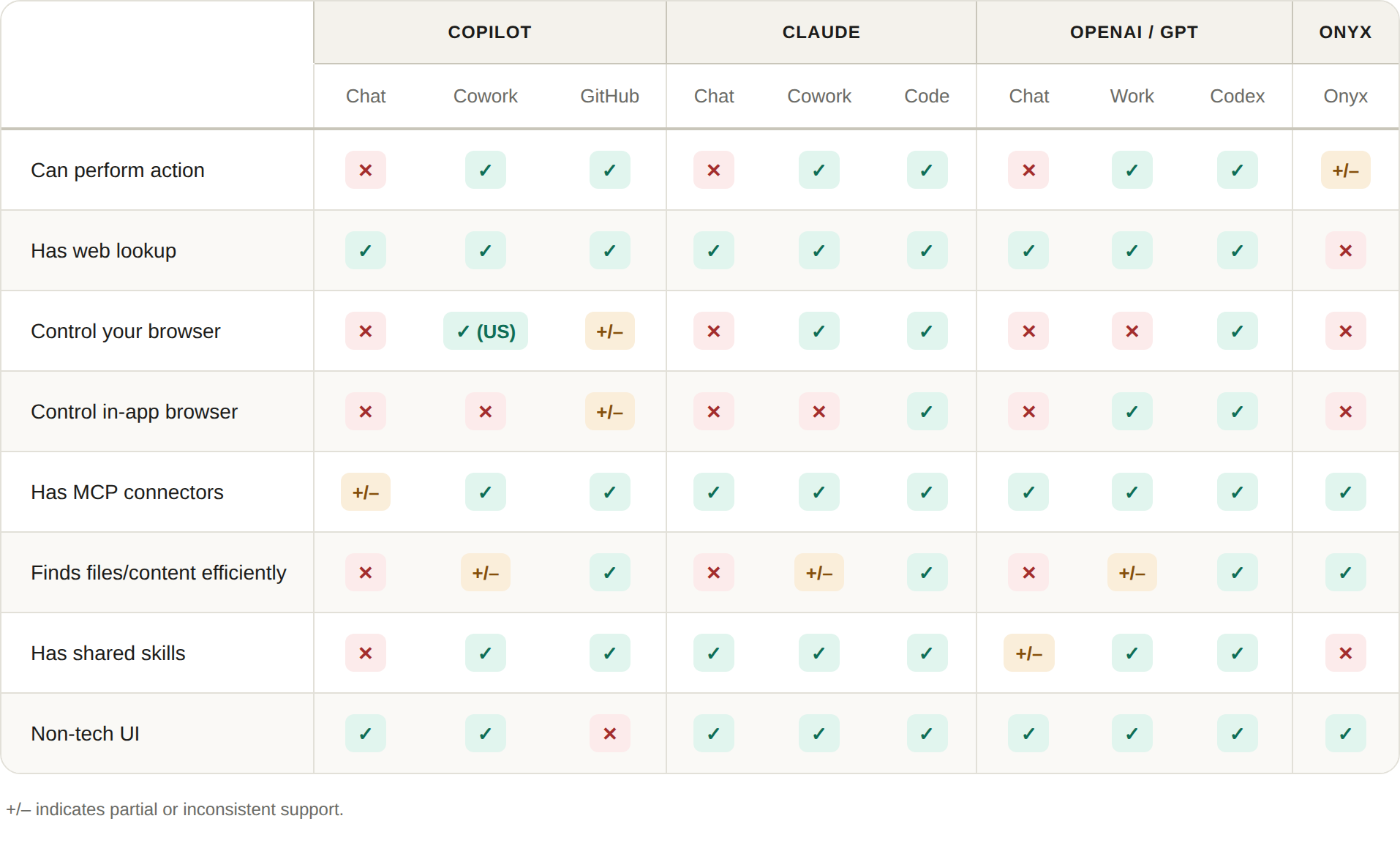
The finicky part is that all of these can still present themselves as a chat box.
One sits there waiting for questions. Another can spend minutes working through your files. Another can operate software. Another has indexed half your company.
Same brain, very different jar.
And once I stopped looking at the brain and started looking at what we could put around it, things became much more interesting.
Give it memory
Imagine your brain having access to 100% of the information you once captured.
I spend a fairly ridiculous part of my working life in calls. Client interviews, technical discussions, project meetings, internal conversations. And like most people, I used to have a highly sophisticated system for retaining all of that information.
My brain.
Results varied.
You remember the important decisions. You write down some notes. Someone sends a follow-up. Three months later you vaguely remember discussing something with someone, somewhere, possibly while multi-tasking.
The information isn't exactly gone. It's just entered that special corporate state where everyone remembers that a conversation happened and nobody remembers the details.
Today, my calls are automatically captured, turned into notes and synced into my second brain.
I no longer have to reconstruct the past before asking a question about it.
I can ask what we decided about a particular project. What concerns someone raised during an interview. Whether we discussed a certain idea before. Why we made a decision months ago.
And the answer isn't based on my increasingly creative reconstruction of history. The original conversation is there. Which is considerably better than my previous retrieval system: vaguely remembering a sentence, assigning it to the wrong person and gradually becoming more confident about it over time.
The AI doesn't need to have your entire company permanently stuffed into its head. It needs to know where your knowledge lives and how to find the right piece when it needs it.
That sounds obvious until you look at how most companies actually store knowledge.
During a recent project, we found information spread across SharePoint, a CRM, personal OneNotes, meeting-note software, Outlook and a small civilisation of Excel files. Some decisions existed only in email. Some lived in personal notes. Some lived exclusively inside someone's biological neural network, which remains annoyingly difficult to connect through MCP.
Giving AI memory therefore isn't really about buying an AI memory product.
It's about making your existing knowledge reachable.
Memory made my AI considerably more useful.
But it was still mostly sitting there, reasoning about all the cool stuff it couldn't yet do.
So I gave it hands.
Give it hands
Memory solved one problem.
My AI knew things.
Unfortunately, knowing things and doing things are two very different skills. As anyone who has ever attended a strategy meeting can confirm.
This is where connectors and MCPs start to matter.
MCP stands for Model Context Protocol. The name isn't particularly important unless you enjoy discussing protocols at parties, in which case we probably attend very different parties.
What matters is what it does.
An MCP connection gives an AI access to another tool. Connect it to your CRM and it can look up companies. Connect it to SharePoint and it can find documents. Connect it to your email and it can work with your inbox. It can even write back to those systems.
The brain suddenly has arms reaching into the software around it.
Except there is a problem.
Not everything has an MCP.
During my experiments I wanted it to actually use my LinkedIn: inspect companies and people, see my connections, and access information only available while logged in.
There is no MCP for that.
A few years ago, this would have been the end of the experiment. If software doesn't expose an API, you can't integrate with it. Or you build some fragile browser automation held together with selectors, prayers and the assumption that nobody at LinkedIn will ever move a button three pixels to the left.
But then I looked at it from a different angle: I don't use an API to access LinkedIn either.
I use Chrome.
So I connected Chrome to my AI.
And told it to use LinkedIn.
It opened the website. Used my existing authenticated session. Navigated to the company. Looked at the people. Inspected connections. Followed links. Gathered the information it needed.
That was probably the moment the jar metaphor properly broke for me.
Because the website itself had become the integration.
We spent decades building APIs so computers could talk to computers.
Now we're building computers that can use the interfaces we made for humans.
And LinkedIn isn't special.
If I can open a tool in my browser, there is an increasing chance my AI can operate it too. Internal applications. SaaS tools. Ancient enterprise software held together by JavaScript from 2014 and the continued employment of one terrified developer named Kevin.
Suddenly "Does this tool integrate with AI?" becomes "Can my AI use this tool the same way I do?" And this is where tools like Cowork and Code become much more interesting than chat.
Which is exciting right up until you realise you've given a probabilistic machine hands, access to your software and absolutely no employee handbook. Fortunately, you can give it one of those too.
Imagination is a bottleneck
This is roughly where I am today.
I gave AI memory.
I gave it access to my tools.
I gave it a browser and, with it, the ability to use software that was never designed to be used by AI in the first place.
And somewhere along the way, the question changed.
I used to ask:
"Can AI do this?"
Now I increasingly ask:
"Why am I still doing this?"
That sounds like a small distinction. It isn't.
Because once you stop thinking about AI as a chat box, you start seeing your working day differently.
That meeting you just had? Why are you writing down what happened?
That information you need from five different places? Why are you opening five different places?
That sacred Monday morning ritual involving three browser tabs, an Excel sheet, two copy-pastes and seventeen clicks nobody remembers the origin of but everyone agrees are absolutely necessary?
Why are you still doing it?
Not everything should or can be automated. Human judgement, permissions, good data and knowing when AI is confidently making 💩 up still matter quite a lot. Giving an AI access to everything and telling it to "have at it" remains a reasonably efficient way of generating material for future security awareness training.
We're spending an enormous amount of time discussing which AI model is smartest. Which benchmark it won. Whether Claude is better than ChatGPT, whether Gemini beat both of them this week, and whether the latest model can finally count the correct number of R's in strawberry without causing an international incident.
Meanwhile, the much more interesting change is happening around the harness.
We're giving it memory.
We're giving it access to our world.
We're giving it hands.
And once I started doing that, I discovered a rather inconvenient new bottleneck.
My imagination.


